Norse story
The death of Baldr
About 4 min read
Baldr’s death survives in texts of different kinds. Baldrs draumar dramatises the dreams and the consultation of a seeress; Völuspá foretells the mistletoe, Höðr’s act and the revenge. Snorri gives the most continuous account, from Frigg’s oaths to the mission to Hel.
Loki’s detailed intervention belongs chiefly to Gylfaginning, although Lokasenna has him claim responsibility for Baldr’s absence. This page distinguishes these different kinds of evidence.
01
Dreams alarm the gods
Baldr has threatening dreams. In Baldrs draumar, the gods gather to understand their cause, and Odin rides Sleipnir to Niflhel, where he summons a dead seeress to speak.
The seeress announces that Hel’s hall is being prepared for Baldr, that Höðr will kill him and that Váli will avenge him. The poem thus reveals the outcome before the fatal act.
02
Frigg obtains oaths of protection
In Gylfaginning, Frigg makes fire, water, metals, stones, plants, diseases, animals, poisons and snakes swear not to harm her son. Baldr then seems invulnerable.
The gods turn this protection into a game, throwing all kinds of missiles at him. Yet there is one exception: Frigg did not ask the mistletoe, which she considered too young.
03
Höðr throws the mistletoe, guided by Loki
Snorri tells how Loki learns of the exception by questioning Frigg in female guise. He picks the mistletoe, gives it to Höðr, who is blind and standing apart from the game, and guides his hand towards Baldr.
The missile pierces Baldr and kills him. Völuspá also names Höðr as the one who strikes and foretells Váli as the avenger. Loki’s full deception is developed chiefly in the prose account, while Lokasenna has him claim responsibility for the loss.
04
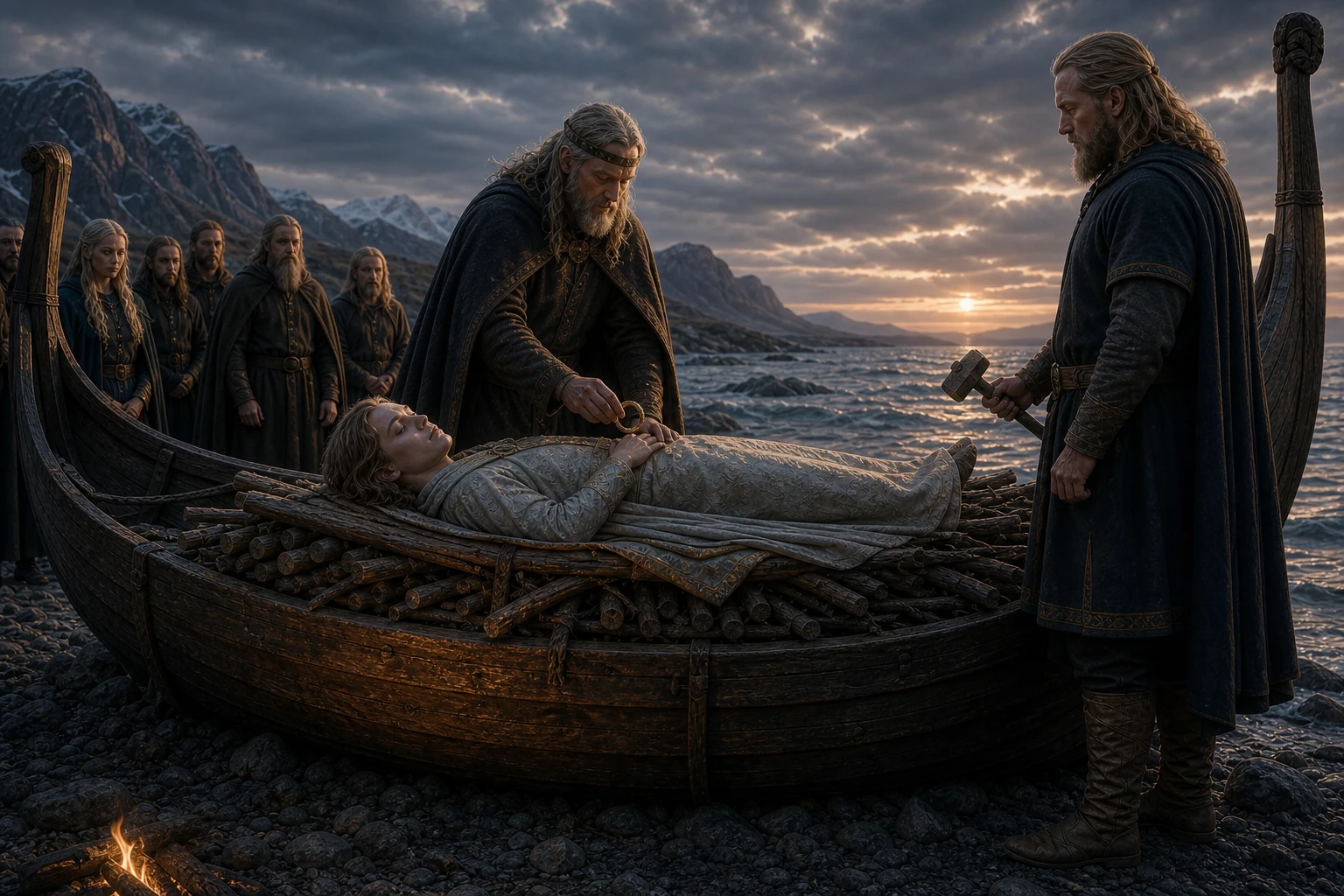
Hringhorni becomes Baldr’s funeral pyre
The gods carry the body onto Hringhorni, Baldr’s great ship. Unable to push it into the water, they summon the giantess Hyrrokkin, who launches it with such force that flames rise from the rollers.
In Snorri’s account, Nanna dies of grief and is placed beside Baldr. Odin lays Draupnir on the pyre, and Thor consecrates the ship with Mjöllnir. The dwarf Lit then crosses his path, and Thor kicks him into the fire.
05
Hermóðr negotiates with Hel
Frigg promises her favour to anyone who will ride to Hel to offer a ransom. Hermóðr takes Sleipnir, crosses the bridge Gjallarbrú and finds Baldr seated in the place of honour in the hall of the dead.
Hel agrees to release him if all things, living or dead, weep for him. Baldr sends Draupnir back to Odin; Nanna also sends gifts to Frigg and Fulla.
06
Þökk refuses to weep
The messengers obtain tears from beings and things, except for a giantess called Þökk. She declares that Hel should keep what she has, so Baldr remains among the dead.
Snorri concludes that Þökk is thought to be Loki, without presenting a scene that directly proves the identification. In any case, her refusal is enough to defeat the all-encompassing condition set by Hel.
07
The loss also foreshadows a return
Baldr’s death is one of the great ruptures preceding Ragnarök. It reveals that oaths, assemblies and the gods’ power can no longer prevent disaster.
Yet Völuspá sees Baldr and Höðr return together in the renewed world. The sources foretell this return but do not describe another series of adventures: it belongs to the world beyond Ragnarök.
Key takeaways
- In Snorri’s account, mistletoe escapes Frigg’s protective oaths, and Loki guides Höðr’s fatal act.
- Hel agrees to let Baldr return if all beings weep for him; Þökk’s refusal defeats the attempt.
- Baldr’s death foreshadows the crisis of the gods, but his return belongs to the renewed world after Ragnarök.
Test your reading
Five questions, an explanation for every answer and a link back to the relevant passage.
Recall the characters and key events.
Sources and passages
Baldrs draumar, Poetic Edda
Stanzas 1–11: dreams, Odin’s journey, Höðr and Váli. English translation by Henry Adams Bellows (1923), whose stanza numbering is followed here.
Völuspá, Poetic Edda
Stanzas 31–34 and 62: Baldr’s death and his return with Höðr. English translation by Henry Adams Bellows (1923), whose stanza numbering is followed here.
Snorri Sturluson, Gylfaginning
Chapter XLIX: oaths, mistletoe, the funeral and Hel’s condition. English translation by Arthur Gilchrist Brodeur (1916).
Lokasenna, Poetic Edda
Stanza 28: Loki claims responsibility for Baldr’s absence. English translation by Henry Adams Bellows (1923), whose stanza numbering is followed here.
Keep exploring
Places to explore
- Hel’s realm (French)
Hermóðr reaches the place where Baldr stays to ask for his return.