Named figures
Urðr, Verðandi and Skuld in Völuspá 20 and Gylfaginning XV.
Fate and the powers of the world tree
Urðr, Verðandi and Skuld are the three Norns named near Yggdrasil in Völuspá. They determine human destinies. Snorri includes this trio but also describes other Norns who attend births.
This collective profile distinguishes these accounts. It follows what the texts say about fate and caring for the tree, without reducing all Norns to three sisters, three stages of life or a single divine family.
Völuspá 19 places the ash tree beside Urðr’s well. Stanza 20 then names Urðr, Verðandi and Skuld: they establish laws and human destinies. In Bellows’s translation, a line also mentions marks made on wood.
The notes to this edition discuss the state and order of the lines. These editorial hypotheses should be distinguished from what the translated poem says. The poem does not describe three separate spinning tasks here, like those often attributed to the Greek Moirai.
Gylfaginning XV describes the three figures beside the well, then widens the account: many Norns come to newborn children to determine their lives. Snorri distinguishes origins among the gods, elves and dwarfs.
Fáfnismál 12–13 also asks about the origins of the Norns who help mothers, and gives several lineages. This variety rules out classifying all Norns solely among the Æsir or inventing shared parents for Urðr, Verðandi and Skuld.
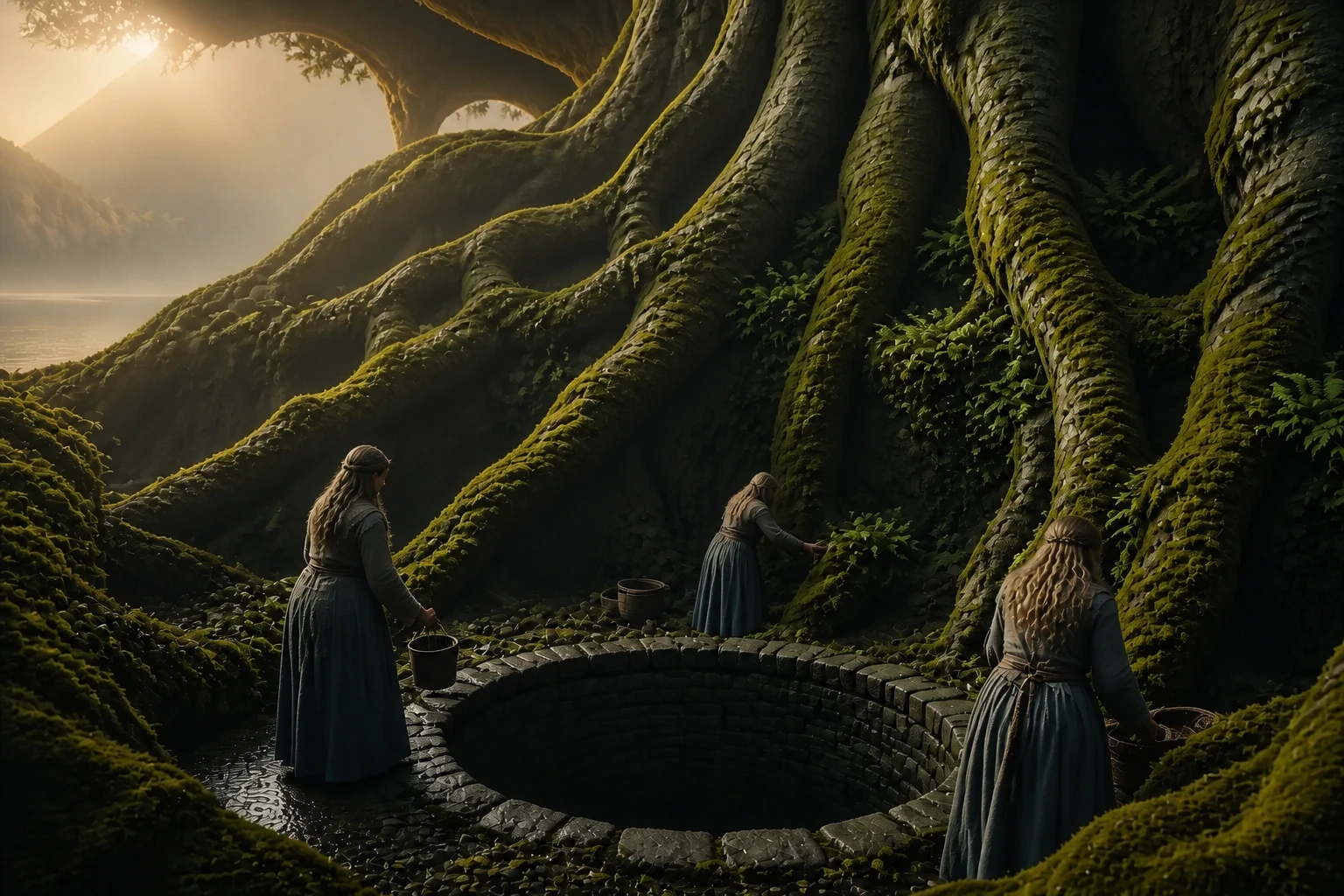
In chapter XVI of Gylfaginning, the Norns who live beside Urðr’s well take its water and the earth around it each day and sprinkle them over the ash tree. This care keeps its branches from drying out and rotting.
The passage therefore connects these figures with maintaining the world as well as with human destinies. The well and the ash form a place within the mythical cosmos: their waters sustain a tree that other beings gnaw at and threaten.
Bellows’s and Brodeur’s notes render the three names with terms corresponding to past, present and future. These are translation choices: they do not establish an age, clothing or individual character for each figure.
The passages used here do not require a pattern of maiden, mother and old woman. This profile’s illustrations show three adults caring for the tree; their faces and clothes remain contemporary artistic choices.
Völuspá 19–20: three named figures beside the tree, laws and human destinies.
Gylfaginning XV and Fáfnismál 12–13: Norns of several origins, without a single shared lineage.
Gylfaginning XVI: water from the well and earth sprinkled over the ash tree.
English translation by Henry Adams Bellows, The Poetic Edda, 1923; numbering follows this edition. The tree, well, names and destinies. Remarks on manuscript readings and the meaning of the names belong to the editorial notes.
English translation by Arthur Gilchrist Brodeur, The Prose Edda, 1916, pp. 28–30. The trio, the many Norns, their varied origins and care for the ash tree using water and earth from the well.
English translation by Henry Adams Bellows, 1923; numbering follows this edition. Sigurd’s question about the Norns who help mothers and Fáfnir’s answer about their different origins.
Original AI-generated illustrations inspired by the care of the tree in Gylfaginning XVI. Appearances, colours, clothing and compositions are contemporary choices; they do not document attested medieval imagery.