Name and variants
Höðr; forms without Norse characters include Hodr, Hodur and Hod.
Norse god
Höðr is the figure whose action brings about Baldr’s death. In Snorri’s account, this blind god stands apart from the games of the Æsir until Loki gives him mistletoe and directs his shot. What seems to be a way of joining the game becomes an irreparable loss.
The Eddic poems also name him as Baldr’s killer and foretell Váli’s revenge. But his story does not end with death: Völuspá brings Höðr and Baldr back together in the renewed world.
Gylfaginning introduces Höðr in a few lines: he is blind, possesses great strength and will remain associated with an act the gods would rather not speak of. Snorri thus foreshadows the tragedy before telling it.
This short account describes neither a childhood nor a long series of adventures. Skáldskaparmál identifies him, among other descriptions, as Odin’s son and Baldr’s killer. These details place the figure without inventing a divine domain for him.
In Baldrs draumar, Odin questions a seeress about his son’s troubling dreams. She names Höðr as the one who will kill Baldr, then foretells the avenger born to Rindr.
The poem builds a scene of revelation in which fate is disclosed to Odin. It does not develop the full mistletoe deception or Loki’s involvement as Snorri later tells it.
In Snorri’s account, Frigg has obtained promises from beings and things not to harm Baldr. The gods then enjoy striking him with projectiles without hurting him. Mistletoe, considered too young to swear an oath, is the sole exception discovered by Loki.
Höðr does not join in: he explains that he cannot see where Baldr is and has no weapon. Loki provides the mistletoe and tells him where to shoot. The projectile strikes Baldr, who falls dead. The narrative thus distinguishes the person who delivers the blow from the one who prepares and guides it.
Baldrs draumar and Völuspá connect this death with swift revenge. Váli, son of Odin and Rindr, fulfils his task when he is only one day old. The poetry describes his refusal to wash his hands or comb his hair before avenging Baldr.
Skáldskaparmál explicitly names Váli as Höðr’s killer. This son of Odin should not be confused with the Váli whom Snorri’s prose mentions in Loki’s punishment.
In the world that follows Ragnarök, Völuspá places Baldr and Höðr together again. Gylfaginning repeats this prospect: they return from Hel and join the gods of the renewed world.
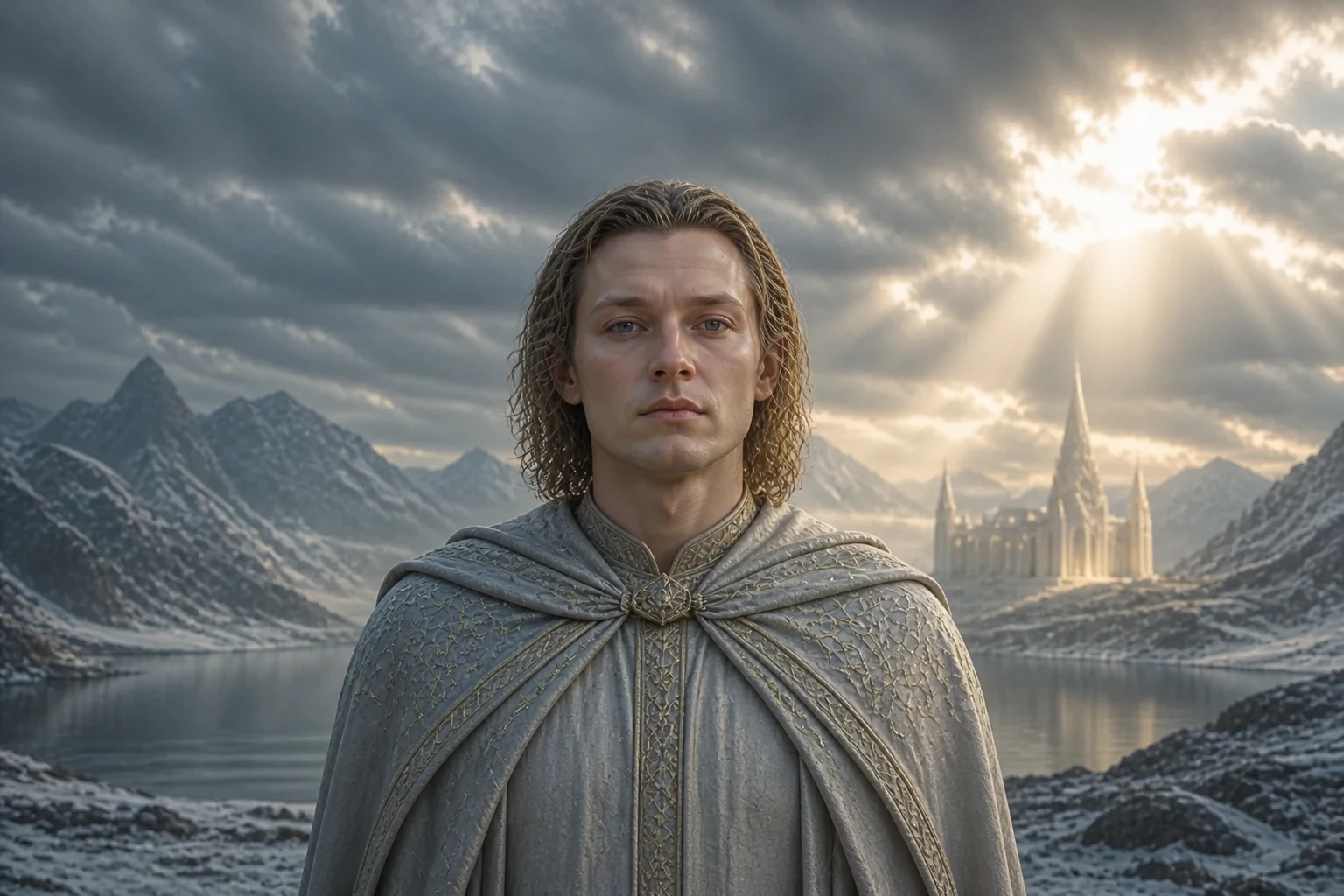
Their reunion gives the revenge story a different outcome. The texts foretell their presence together, but describe neither a scene of forgiveness nor a detailed reconciliation. This profile’s portrait is a contemporary artistic interpretation, not an attested ancient depiction.
The poetic passages cited name the killer and foretell revenge without developing the portrait of the blind god given in Gylfaginning.
These passages are not enough to make Höðr a “god of winter” or a “god of darkness”. His place here is described through the actions found in the sources.
The seeress questioned by Odin names Höðr as Baldr’s killer in Baldrs draumar.
In Snorri’s account, Loki gives Höðr the mistletoe and guides his shot at Baldr.
After Ragnarök, Höðr returns alongside Baldr in Völuspá and Gylfaginning.
Höðr’s portrait, Loki’s intervention and the return from Hel. English translation by Arthur Gilchrist Brodeur, 1916; numbering from this edition.
Váli as avenger and killer of Höðr; Höðr as Odin’s son and the one who launches the mistletoe. English translation by Arthur Gilchrist Brodeur, 1916.
Odin’s questions, the foretold killer and revenge. English translation by Henry Adams Bellows, 1923; numbering from this edition.
Baldr’s death, mistletoe, revenge and the presence of Baldr and Höðr in the renewed world. English translation by Henry Adams Bellows, 1923; numbering from this edition.
Explore related figures, places and stories. Pages available only in French are labelled.
Place the death of Baldr within the wider world of the Æsir.
Find Odin’s paternity and the source’s silence about Höðr’s mother.
Höðr connects Baldr’s death, Loki’s manipulation and Váli’s revenge. His return with Baldr reminds us that the Norse narrative does not end solely in destruction: it also opens onto a future of which the texts offer only a few glimpses.