Greek name
Hades / Haides (ᾍδης / Ἅιδης)
God of the underworld
Brother of Zeus and Poseidon, Hades rules the realm of the dead, far from the light of Olympus. He is not a demon of later traditions, but a strict and unyielding ruler who upholds order in the afterlife. Under his authority, the souls of the dead enter a structured world with rivers, judges and regions of reward or punishment.
The Greeks often call him “the Unseen One” and avoid speaking his name out of respect or fear, preferring indirect names and titles. He embodies an inevitable part of mortal life: cold, but necessary.
Hades receives the realm of the dead when the sons of Cronus divide the world. He is not a god of evil: he guards a necessary realm, dark and without an ordinary way back.
His power rests on stability. Souls enter his kingdom, riches remain beneath the earth, and the living must not overturn the order of the dead.
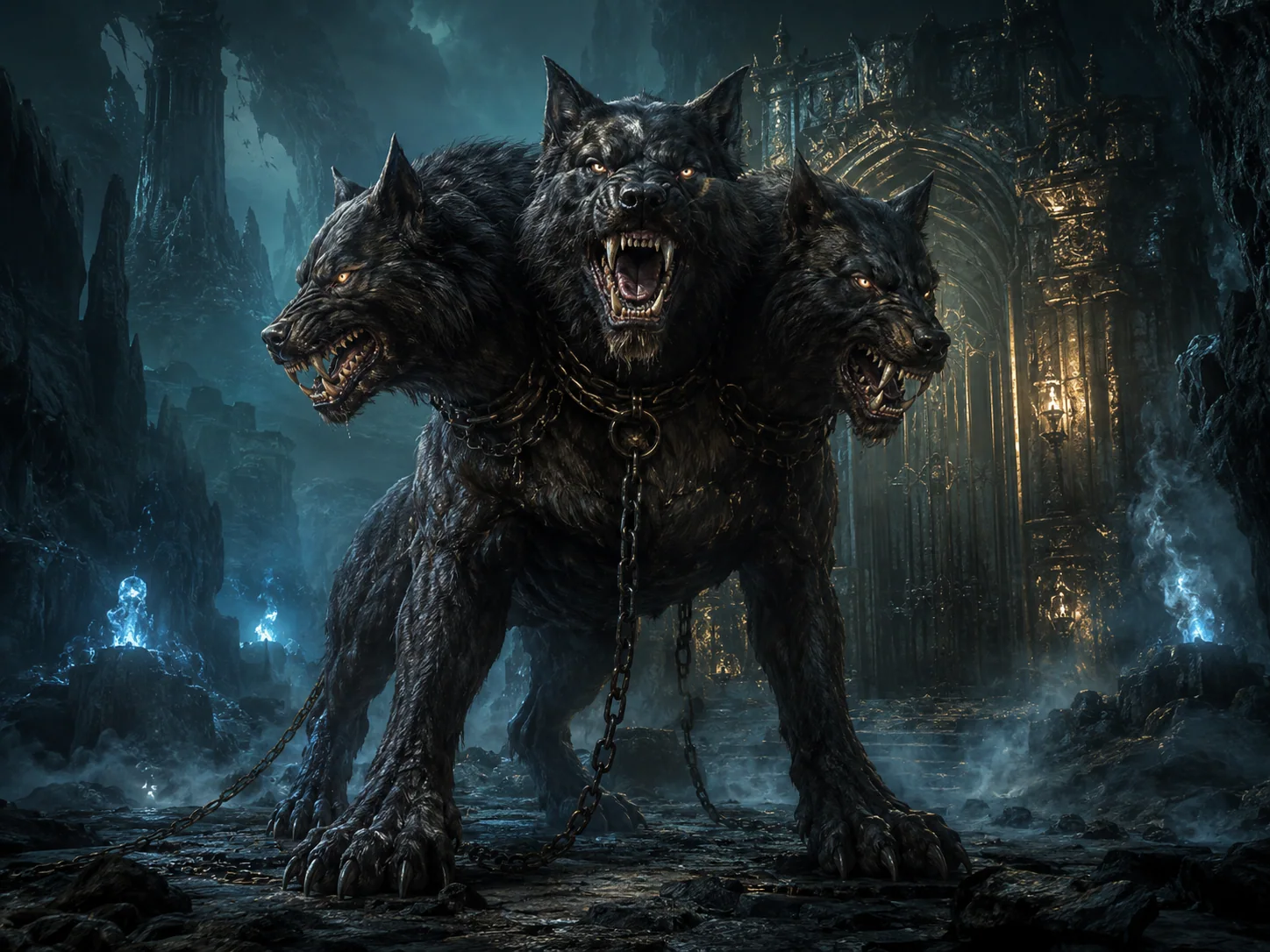
The myths of Hades are mainly about crossings: descents into the underworld, impossible returns, rare negotiations and heroic exceptions. Persephone, Demeter, Charon and Cerberus shape this world of boundaries around him.
His profile belongs alongside the stories of Orpheus, Persephone and the judges of the dead. Hades is less an adversary than the guardian of a limit.
Hades abducts Persephone, Demeter's daughter, to make her his queen. In despair, Demeter lets the earth wither. An agreement is eventually reached: Persephone will spend part of the year in the underworld and the rest with her mother. This cycle explains the changing seasons.
To bring Eurydice back, Orpheus descends into Hades's realm. His song moves the royal couple, who agree to release her on one condition: he must not turn around before reaching the surface. He looks back too soon, and the law of Hades allows no reprieve.
In Hades's realm, souls are judged by Minos, Rhadamanthus and Aeacus. Some are sent to the Elysian Fields; others go to Tartarus for endless punishment, like Sisyphus, condemned to push his rock, or Tantalus, forever suffering hunger and thirst.
The children of Cronus and Rhea, their swallowing, and the birth and victory of Zeus. English translation: H. G. Evelyn-White, 1914. This reference supports those specific points.
The birth of Cronus's children, the help given to Zeus and the division of the realms. English translation: James George Frazer, 1921. This reference supports those specific points.
A specialist collection of ancient passages, genealogies, variants, iconography and references to source texts.
A French overview to use as a starting point for names, variants, cultural context and bibliography.
Explore related figures, places and stories. Pages available only in French are labelled.
Explore the story that connects Hades, Demeter and Persephone.
Follow the musician's descent and his attempt to bring Eurydice back.
Find the rivers, guarded passages and stories of the realm of the dead.
For the Greeks, Hades is neither a tempter nor a lord of chaos: he is the final boundary between life and death. People rarely seek to worship him out of affection, but they respect him deeply because he keeps the order of the world intact.
In this encyclopaedia, Hades offers a way into the wider world of the afterlife: its rivers, judges and regions, and the heroes who dare to visit the dead. His profile connects many other figures and stories.