Greek name
Demeter (Δημήτηρ)
Goddess of the harvest
Demeter is more than the goddess of crops: she is the power that makes the earth a home for humankind. Through her, seeds sprout, grain becomes bread, and the seasons take on meaning in farming, family life and religion.
Her grief at the loss of Persephone gives this fertility a tragic depth. The harvest depends on a fragile balance of family bonds and cosmic order; when that balance breaks, the earth becomes barren. Demeter connects daily nourishment with larger questions of grief, return and hope.
Through Demeter, the Greeks understood fertility as a relationship. The earth does not produce crops automatically: it responds to a balance between gods, people, seasons and rituals.
The goddess therefore reaches far beyond agriculture alone. She sustains the life of the community, from the household to the great civic festivals that give thanks for the harvest and renew its power.
The myth of Persephone shows Demeter wandering and refusing to feed the world while her daughter remains in the underworld. Her withdrawal expresses overwhelming grief, powerful enough to bring the living world to a halt.
But her story does not end with loss. The agreement that allows Persephone to return at regular intervals turns sorrow into a cycle. For Demeter, hope does not erase absence: it offers a way to live with it.

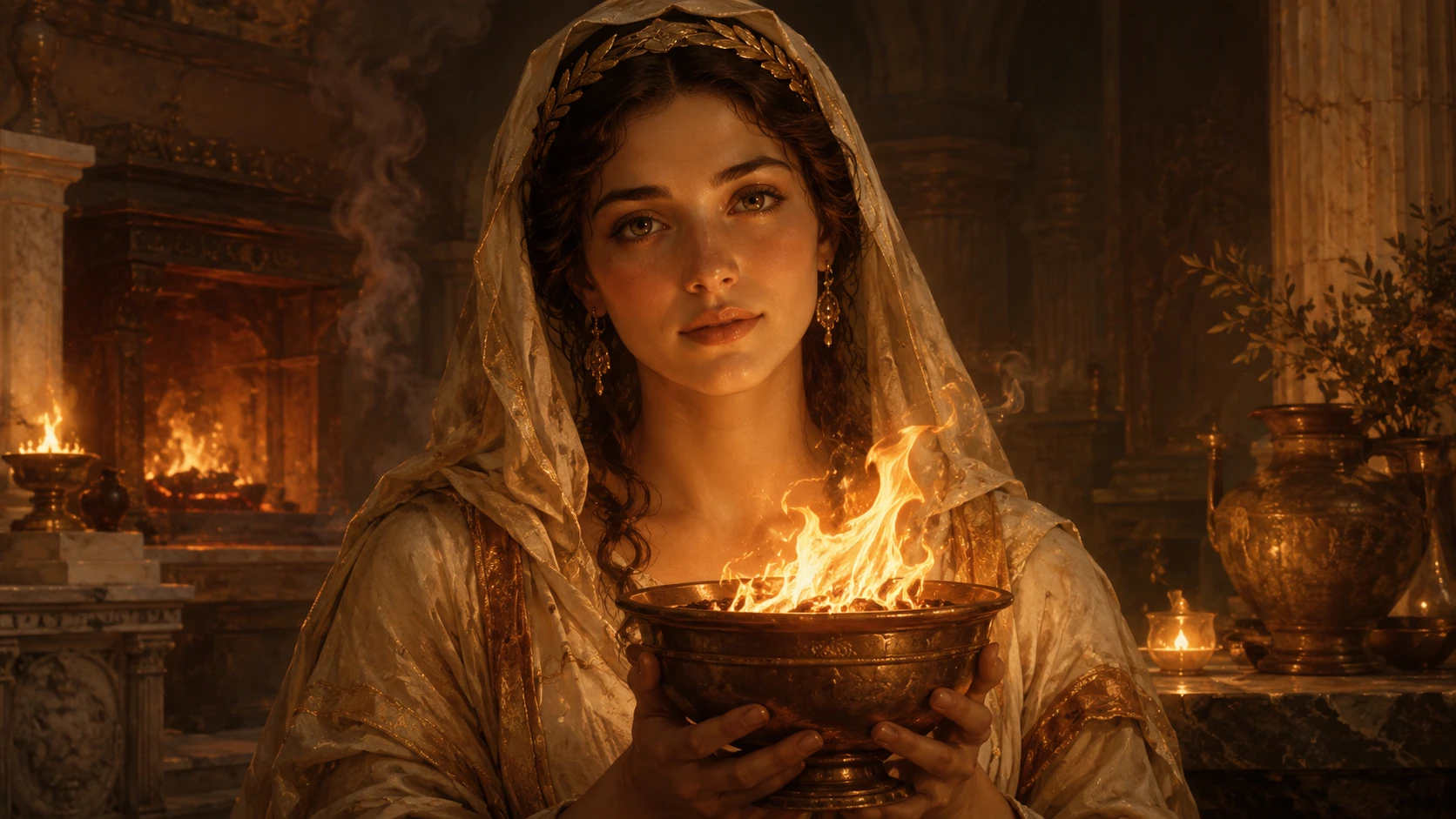
When Hades carries Persephone away, Demeter leaves Olympus and withholds the earth's fertility. Mortals discover that their bread also depends on an unseen balance between the gods.
At Eleusis, Demeter becomes central to a major cult of initiation. Its rites offer more than agricultural knowledge: they hold out hope for life after death and give meaning to the cycle of life, death and return.
Welcomed into King Celeus's household, Demeter tries to make the child Demophon immortal. The interruption of her attempt recalls that mortals may receive extraordinary gifts from the gods, yet cannot simply leave their human condition behind.
The children of Cronus and Rhea, their swallowing, and the birth and victory of Zeus. English translation: H. G. Evelyn-White, 1914. This reference supports those specific points.
The birth of Cronus's children, the help given to Zeus and the division of the realms. English translation: James George Frazer, 1921. This reference supports those specific points.
Demeter's stay at Eleusis, Demophon, the famine, Persephone's return and the teaching of the rites. English translation: H. G. Evelyn-White, 1914. This reference supports those specific points.
A specialist collection of ancient passages, genealogies, variants, iconography and references to source texts.
A French overview to use as a starting point for names, variants, cultural context and bibliography.
Explore related figures, places and stories. Pages available only in French are labelled.
Follow the search, the famine and the agreement that allows Persephone to return.
Read about the goddess's stay with Celeus, the child Demophon and the teaching of the rites.
Explore the sanctuary and its place in the stories of Demeter and Persephone.
Find her parents, siblings and daughter in the Greek family tree.
Demeter remains a powerful figure because she brings together experiences that human societies never fully separate: working the land, losing someone close, waiting for a return and seeking a promise of continuity through ritual.
Her story leads naturally to Persephone, the underworld, initiation rites and the ways Greek mythology connects with the everyday life of seasons and communities.